Latest News

Enigmatic India

This blog captures the life experiences of the Enigmatic India team in the beautiful and enigmatic country of India.We capture our experiences through our writings, photos and products that depict the very essence and fabric of India.Through this platform, we invite you to join us in our journey as we explore.
Showing posts with label culture. Show all posts

Saturday, October 10, 2020

Artisans Around Us: Md Khurshid Ansari

“You got to pack anything, whenever you make a sale and that is an opportunity”: Khurshid Ansari

Md. Khurshid Ansari is a craftsman of Jute & Cotton working as a trainer in a production unit at Rishra close to Hooghly, in West Bengal. His organization is a part of the Bharatiya Mahila Sangathan since thirty years. Nine years into this organization as a craftsman, Mr. Khurshid has gained a great deal of recognition worldwide. Mr. Khurshid is not only a great artisan himself but also contributes to the society as a trainer at the Aditya Birla Institute. He has received many awards for his contribution to the society including Aditya Birla Jan Seva Trust for two years.

His organization deals with jute & cotton bags, canvas & Tisco bags. They make workplace  lunch boxes (
which is their best-selling product). Apart from this they supply gunny bags to Supermarkets/malls. In the initial days, he struggled a lot to form his team, which comprises mostly women. However after months of training, the team is well settled and delivering well. The supply chain for the products  involve procuring the jute and cotton directly from the mills  through an agent. The raw materials are  bought as per the frequency of orders and it is converted into finished good in an impressive line-up of the  twenty-five (25) machines for  Jute  products  and  twelve (12) machines for Cotton products. 

He definitely wants his products to go global through online channel, however due to very high packaging and shipping cost, he is unable to do so. This is limiting the sale of the products just to exhibitions and small shops/retail outlets. As asked by our team regarding how the Jute and Cotton bags will be reach globally, he quoted you got to pack anything whenever you make a sale and that is an opportunity that strikes us”. As there's slowly a ban of synthetic resin packaging, the demand of jute and cotton bags has seen an increase. He has seen that the craze for such eco-friendly products is increasing both in  Asia and Europe. Traveling within the country with these merchandise to various exhibitions, Melas, International Trade Fairs, noted exhibitions in cities. He has gained heaps of expertise regarding client preferences and also understanding the dynamical demands. Apart from these, he has tied up with a chain of providers in Odisha, which has a good uptake on Jute products (as it’s a Temple State and jute is considered to be a lucky material as per Mr. Khurshid).


Through this story he wants to reach out to individuals who support buying eco-friendly products /merchandises and also make us aware of the impact he and his organization is creating in generating livelihoods in his locality.


(Interviewed by Neha Dash, KSOM 2nd year Student during her internship with EnigmaticIndia. Photos have been provided by Mr Khurshid)

Saturday, October 03, 2020

Artisans Around Us: Sunita Mohanty

"If you dream it,you can do it": Sunita Mohanty

For each person out there who desires to realize their goals, their dreams however have 
faced tons of Obstacles, Doubters, have created mistakes and so finally given up…Well here’s the story of 1 Odisha woman who made it all on her own by breaking out of all the prevailing stereotypes. Mrs. Sunita Mohanty, associate businessperson and also the owner of Neena Crafts, five years past was a bit like the other Painter trying to find a chance to touch the lives of others through her work however rather than waiting, she set to form for herself a platform wherever she may level up in achieving her dreams and thus Neena Crafts was fashioned.


Neena Crafts is presently concerned with creating and commerce of Paintings together with the illustrious Pattachitra art form that is understood for its involved details and mythological narratives inscribed in it. Not solely Pattachitra however Neena Crafts additionally features a form of Wall paintings, hand paintings and even saree paintings that are splendidly referred to as Kalamkari. However what interests me a lot of is that the Pattachitra art form, for it's galvanized by the Hindu Mythology and to create only 1 Pattachitra it takes months or maybe a year of labour and patience to place in such a big amount of range of natural colours and portray a story out of it. The saree paintings and even the wall paintings created by Neena Crafts might be of our own alternative, it’s like we tend to may wear art in our sarees and walk and even adorn and style our dream house with all the fashionable nonetheless ancient wall paintings.

As we all know that there's a lot of demand of the hand sewn merchandise within the market and particularly paintings like Pattachitra and Wall paintings would need masterful artists of that, Neena crafts has recruited well-trained and economical operating individuals which permits it to finish the received orders from customers over the year and even reach resolute more audience by putting up their work in several Craft Exhibitions. Until currently they have their store in Odisha wherever the demand of Pattachitra paintings is extremely high however they're yet to create their on-line presence within the market.


It's true that Mrs. Sunita Mohanty broke out of the notion set that says that ladies shouldn’t work after wedding for she took a step and created Neena Crafts which is with success running nowadays, for at that point she gave her Painter Self an opportunity to Evolve!


(Interviewed by Neha Dash, KSOM 2nd year Student during her internship)

Sunday, January 28, 2018

Dansborg Fort, Tharangambadi : Piece of Danish Settlement in India

Vinod my friend called many months back and told me that we should visit Tharangambadi or Tranquebar, when we were in Chennai next. This stuck with me for quite sometime and when we planned a trip to Puducherry, visiting Tranquebar was definitely in the offing.

Fort Dansborg
The drive from Puducherry was only ~120 Kms and with a break at Chidambaram, Thillai Nataraja temple the journey didn't seem difficult at all. As we were approaching this place, my mind was racing - when did the Danish rule India. Had heard and read about other European settlers like the French, Portuguese, Dutch and the English but never about the Danish rulers. Maybe my knowledge of history was in sufficient - so a quick search on Google threw up this map. Crazy enough- there were three Danish settlements in India - Tranquebar, Serampore(Bengal) and Nicobar - governed through the Danish East India company set-up for trading purposes(mostly spices).

European Settlements in India : Source Wikipedia.
As we approached , I was expecting to see a huge fort, structure like the Rajasthan Forts but it turned out to be a small orange-pink garrison(large outpost) kind of thing. Fort Dansborg apparently is the second largest fort built by the Danes after Fort Kronborg. As the history goes it was build by Danish Admiral Ove Gjedde in 1620 after entering into an agreement with the Thanjavur King, Raghunath Nayak.

Bay of Bengal - view from Fort - Rusted Canon is also visible
It faces the Bay of Bengal and there is a beautiful beach with a lot of boats adorning the white sands. The structure is built in Danish style(as stated in the museum - I don't know a bit about architecture and rely on acquired information) with large halls, column structures, projecting drapery. Apparently it had the governors residency, kitchen, soldiers quarters, armoury, store rooms and strong walls in a trapezoidal shape. One can take a walk along the fort walls and enjoy taking photos. I enjoyed watching the sea from the Fort and the cool sea breeze was soothing. Imagined how the governor would have enjoyed his evenings and early mornings back in the 17th Century. If you are the inquisitive kind, there is a museum inside and though not much is there, some piece of history can definitely be seen.

Artefact in the musuem
As you come out of the Fort, you can visit the Zion Church, Jerusalem Church, Town Gateway, Masilamaninathar Temple and other buildings from that period. Couple of bungalows have been converted to hotels by the Neemrana group and one can stay there. Overall the walls around the citadel were not meant to weather military attack, rather protect from cavalry raids. Well if you are hungry there are a few ice-cream & bhelpuri/masala puri vendors just outside the Fort gate. The place is both child and elderly friendly and a tourist hot spot.

View of the Fort  facing the sea
This visit to Fort Dansborg was quit enriching and filled an unknown void about my knowledge of European Settlements in India. If you are in Puducherry take time off and visit this place.

(Contributed by Sandip Mishra)

Saturday, July 22, 2017

Trip to Varanasi, Uttar Pradesh

We finally set off in the month of May to the oldest city ever-Varanasi. Umm, Banaras? No, Kashi! What’s in a name anyways!

The scorching heat, which was a little over 42C, didn’t actually seem to dampen our spirit, although a lot of people had cautioned us against it.

Well, the moment arrived, and there we were! Heading towards Ganapati Guest House, where we would be spending our next three memorable days. A little about why we chose this guest house and not any other. Its right on the bank of the river, alongside all the Ghats. There’s a balcony with a view of the Ganges which gives the guest house a breathtaking ambience. It is just a couple of minutes away from the main temple Kashi Vishwanath Mandir, although a little away from the main road. This meant that we would get dropped at a spot that was a15-minute walk away from the place of stay. It was worth it all, because the uniqueness of Banaras is its streets. The Ghats, the steep stairs and of course the legend of our Ganga maiyya and Shivji deciding to stay here for good!!

  At probably seven in the evening, the moment we checked into the hotel and stepped into the balcony, I looked onto my right, only to see the famous Dhashwamedh Ghat with the Ganga Aarti ongoing, and a large fleet of boats on the river, with loads of yellow lamps-dreams floating. An inexplicable visual, one must watch it to feel it!
We quickly hit the road to pay our respects to Shivji before beginning our journey. It was amazing to see the 4 feet narrow roads that led to the temple. Scooters, Gau Mata, people, everything fit so beautifully well into the small streets!

Behold! My dream came true as I stepped into the Kashi Vishwanath temple, that I had been yearning to visit (and I have no reason why) for a long, long time now.

The next morning, we set off for the boat ride, again an experience of a view into the life on the Ghats. If one Ghat had life in abundance, there were two others- “Harishchandra Ghat” and “Manikarnika Ghat”-  that were buzzling with the silence beyond life. While there were some who had just gotten out of the river after a holy dip, there were some others, whose bodies were put on the funeral pyre. There were also 
some bodies that were waiting, for their turn, to receive Moksha in the holiest place on this planet. Once, we saw 16 pyres at a time! They say, this is one place where the cremation happens on all 365 days of a year.
Amidst the sunrise, people, the floating shops for memoirs, the swim of the kids, the intense prayers, and the hustle and bustle, there I was, witnessing it all, with no words to explain how I felt.

Foooooooooood! Kachori, kulhad chai and jalebi. That was in our mind, as we set off towards the main road...yumm…we were already thinking about our next food destination! :’)

After a leisurely freshening up, we set off to the main temple again, and many prayers later, we realized the heat was picking up, and were advised against heading anywhere until evening.So, we decided to hit the main road in the hot sun, to find good food. Not that Ganpati Guest house doesn’t provide food, we were just too ambitious. And yes, we did find a restaurant, but there was nothing banarasi about the food they served. On our way back to the guest house, I couldn’t stop ogling at the stores that had the banarasi sarees on display. At 40C, after a heavy-not so banarasi-meal, there went my foot on a hole-y road, and cracked me up with a bad ligament tear. I quickly wrapped my ankle up with a bandage and set off again! This hole-y incident somehow decided the course of our next two days and how!

When walking is the only choice you have as there are no vehicles (that fit into the 4ft narrow lanes and not hit the Gau Mata at the same time), I never even fancied a thought that I could push myself so much. We kept walking.

A good rest later, we moved towards the evening boat ride, followed by the world-famous Ganga Aarti- a ritual par excellence.  And then we headed to the Kashi Chaat Bhandar, a small shop at the main road, which offers lightning fast service in spite of the great rush they have to handle, and serves great food! Favorite in the menu? Has to be the tangy tamatar chaat! Don’t even try forgetting to order it.


We set off to Sarnath-where Lord Buddha delivered his first sermon, the next day, in a vehicle booked by the
guest house, and on our way, visited the Sankat Mochan, and the Durga temples. It’s amazing to see the beauty of Sarnath, the teachings of Buddha, and the museum, all of which were calm and peaceful- offering a sharp contrast to what happened in Varanasi. 

We went to an outlet nearby to check out some Banaras memoirs, and once we were done, we returned back to the hotel and relaxed.


Khaikepaanbanraswala every day ;) you are not supposed to chew the paan. Atleast that’s what the vendor advised us to do.  It just melts in your mouth and gives you a chill feeling!

Day three, we were all set to return, and lo! How could we miss out on the KalBhairav temple!! We rushed to his abode, prayed and then came back for a leisurely lunch at Ganpati Guest house, as we started packing for our trip back home. *sobs*. I know I am going back again. This time in a colder season.
Banaras is in the Ghats. You have to feel it, you have to live it. With friendly people around, who are always willing to help, the ancient city of Varanasi still retains its fervor. Isn’t it surprising to see a city that hasn’t let modernization change its core even a bit? That’s Varanasi for you in a nutshell. A beautiful experience that makes you stretch beyond your limitations.:’)

(Contributed by Gayatri Kuppa, photo/images rights with Gayatri & Nikhil Kuppa)

Saturday, May 27, 2017

Trip to Madikeri ( Mercara Fort), Coorg, Karnataka

Madikeri Fort, One of the entrances
The Madikeri Fort (Mercara Fort) was first built in the 17th century by Mudduraja and subsequently developed by Tipu Sultan, Doddavira Rajendra, The British and finally Linga Rajendra from the Wadiyar(Wodeyer or Odeyer) dynasty. The Fort wall runs all along the fort and there are many view point to track enemy and also shoot at them from many vantage point

The entry to place is free and one can visit it between 9:00 a.m. and 5:30 p.m.

Palace, currently housing the Deputy Commissioner's office
The fort has a palace which was built using European style of architecture and at the entrance there are two horses sculptures holding the balcony. We couldn't enter this building as it is now the office of the Deputy Commissioner's and am sure access is restricted. The complex also has the Ganapathy temple.
Two large elephant structures
In one corner there are two large elephant masonry structures. Not sure the origins of this or the purpose. These are majestic and eye catching.
St Marks' Church
Finally it also has the St Mark's Church which was built in 1834 and now open as a small museum maintained by ASI. There are quite a few artefacts in this museum mostly weapons, idols and one special section dedicated to Field Marshall K M Cariappa.

Overall a short trip and it gave some insights into the history of Kodagu.

(Contributed by Sandip Mishra)

Saturday, January 07, 2017

Trip to Pink City Jaipur, Rajasthan


Amber Fort
What kind of images would come up in your mind when the word Rajasthan in mentioned?
  • Forts
  • Palaces
  • Tales of Valor
  • Miniature Art
  • Precious stones
  • Colorful garbs
  • Puppets
  • Festivals and Fairs
  • Camels and Elephants
  • Old World Charm
Trust me, Jaipur is all this and lots more. I recently revisited the Pink City and it was a treat.
Sheesh Mahal, Amber Fort
Jaipur, the Pink City and the Capital of Rajasthan is approximately 250 kms away from New Delhi. It’s well connected by road, rail and air. Built in 1727 it is one of the well-planned cities of India. The City is divided into 9 blocks with 2 blocks housing state buildings and palaces and 7 blocks for the public. These blocks are surrounded by well-fortified walls and 7 strong gates like the Tripolia gate, Sanganeri gate etc.
A little about the history of Jaipur. Prior to Jaipur, Amber (pronounced as Amer) was the capital of Rajasthan. The Kachchawa clans of Rajputs were among the first to arrive at Amber Fort. And they built amiable relationships with the Moghul dynasty. Which is one the reasons why Jaipur monuments are a mix of Rajasthan and Moghul architecture. Raja Bihar Mal gave his daughter (Jodha) to be emperor Akbar’s wife.  Subsequent Kings like Bhagwan Das, Man Singh, and Jai Singh cemented their relationship with the Moghul and continued to operate out of Amber. However Sawai Jai Singh II moved the capital from Amber to Jaipur. Jaipur was built in consultation with some of the best mathematicians, astronomers and a very reputed architect Vidyadhar Bhattacharya. The colour pink was chosen to cut down the glare of the suns rays.
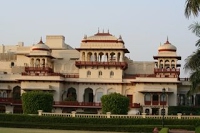
Rambagh Palace
We spent 3 days in Jaipur. Stayed at Hotel Rambagh Palace, which was built in 1835 by the Queen of Jaipur but later converted into a heritage hotel run by the Taj group. The hotel is beautiful – huge room with high ceilings, arches, facades and jharokas. Paintings of all the Kings are hung in different places. The restaurants all remind you of an era long gone- the grandeur and the look and feel of those olden days are still maintained. The Hotel houses a Golf club and Polo grounds and a wonderful garden- a veritable delight for bird watchers.  There are over 75 varieties of common and rare birds.
Entrance to Amber Fort
We spent a day at the Amber Fort and Palace. Set against the rather drab and rugged mountain background, the honey colored Fort and Palace are a sight to watch. Earlier the Jaigarh Fort used to protect the Amber Palace but later the Amber Fort was constructed. The Palace is beautiful and overlooks the Maota Lake below. Parts of the movie Jodha Akbar were shot there. What I found the most  alluring was the Sheesh Mahal- a single light was reflected into multiple images. The Diwan-e-aam, the Diwan-e-Khaas, the Jai Mandir, the Kali temple ,the latticed walls and the intricate gardens all have stories to tell. Please don’t miss out on the light and sound show of Amber Fort.
Moata Lake
After a visit to the Amber Palace we went to the City Palace. The royal family still resides in a portion of the city palace, the Chandra Mahal. It is a blend of Moghul and Rajasthan Architecture and has numerous gardens and courtyards. Other places, which caught my interest, were

Hawa Mahal
Hawa Mahal- The Palace of Winds, which was built by Sawai Pratap Singh. It overlooks the marketplace, the Sireh deorhi Bazaar. It is a wall (behind which there is a 5 storied building) and in olden time the ladies of the royal family used to watch the happenings in the market place through the multiple windows of the Mahal. It now houses a museum.

Nahargarh Fort
Nahargarh and Jaigarh Forts- The Jaigarh Fort is close to the Amber Palace and Fort and the Nahargarh Fort is a little away from Jaipur. The Nahargarh Fort is a beautiful place and though it doesn't attract many tourist compared to Amber Fort it is a must see place.          

Jal Mahal- Palace within a lake, this was created in 1799 by constructing a dam within the lake. In the evenings it is lighted up beautifully
Albert Museum
Albert Museum- a public museum situated in the Ram Niwas Bagh. 
Apart from these the Jantar Mantar, Dolls museum, Birla planetarium are common tourist spots. For those who want to visit religious shrines the Govindji temple, Jagat Shiromani temple and the Lakshminarayan temple are places to visit.  
Jaipur has extreme temperatures so it would be a good idea to check out the weather before you travel.  It’s a shoppers paradise with MI road, Tripolia bazaar, Johari bazaar, Khajane walon ka rasta and multiple other places where one can shop for textiles (the Jaipuri rajais, bedcovers), semi precious stones,  lac work, marble works, miniature paintings. . If you visit during the festival seasons the Gangaur Festival, the Kite festival are quite famous.
Before you leave Jaipur don’t forget to gorge on the delicacies of the Laxmi Misthan Bhandar. Amazing Rajasthani food!.I left Jaipur with memories of a beautiful city full of history and culture. And of course lots of clothes and Jaipuri rajais J.
Contributed by Jayashree Mishra and first published in Enigmaticindia.info site in July 2011

Trip to Aurangabad(Built by the Throne), Maharashtra


Ajanta Caves
Declared as the tourist capital of Maharashtra, Aurangabad(named after Emperor Aurangzeb) is also known as the "City of Gates". I did a weekend trip to Aurangabad and kind of fallen in love with the place...wish I lived in a place like that.

From Mumbai took the Devagiri express at 9 PM on a Friday evening. After a long time travelled in a long distance train-the journey was uneventful-the train left on time and reached around 4:30 AM. People had been scaring and discouraging me not to go there in the peak of summer- but reached there to find that it was surprisingly cool- it had rained the previous day. What struck me most was the cleanliness and absence of crowd (I guess any place after Mumbai would feel the same way).

Ellora Caves
Left for Ajanta after breakfast- took us around 2 hrs by road…the scenery and landscape isn’t much during the summers-people say it looks beautiful after the rains. Ajanta has around 26 caves- but 4-5 of them have paintings- the rest have carvings. The paintings are amazing considering the fact that they are so old- they are 3 dimensional and based on the Jataka tales…the caves are lined in the form of a horse shoe. In earlier times there was a river/spring flowing by and water used to cover the floors of the caves and sunlight would reflect from them and light up the painting and the walls ….To preserve the paintings, photography is not allowed inside. After wandering around the caves for a long time…Spent some time at the local shop that sells semi precious stones…then went back to the hotel.

The second day turned out to be pretty hectic…went early morning to Ellora. Ellora consists of 34 Hindu and Buddhist caves. Was awed by the main cave- cave 16-the Kailashnath temple – a free standing monolith carved top down from a single mountain rock. It depicts scenes from the Ramayana and Mahabharata. The statues look so full of life! The Buddhist caves are beautiful- I could have spent an entire day there…but didn’t have the time…After a couple of hours went visiting temples….there’s a Jyotirlinga  temple- and then went to a Hanuman temple- where the idol of Lord Hanuman is in a sleeping position. 

En route stopped at the Daulatabad Fort- another lovely place…loved the defense mechanisms they have- the mazes…the trenches, moats, watch towers- imagine the amount of thinking that must have gone into it. It was an amazing trip into history. 
Bibi Ka Maqbara

 In the evening went to Bibi ka Maqbara- the grave of Aurungzeb's fourth wife…it is an imitation of Taj Mahal. It is built on the same line but of half marble and the rest of seashell powder. Owing  to its similarity its called the Mini Taj of the Deccan. Due to lack of water, maintenance of the gardens isn’t what is should be. 

After that went to a place called Panchakki- at first glance it looks like a mere pond- and you wonder what’s so great about it- its actually a reservoir which is fed by water from a source that is about 5-6 kms away….water comes in through earthen pipes…its a great engineering feat considering that it was built in the 17th century ….And a question crossed my mind- if problems like these had a solution then …..whats stops the govt now..to take measures to solve people’s problems…There’s a small place near Aurangabad called Jalgaon (the name seems ironic!!)- where water supply is there only once a week.

The day was almost coming to an end- had to catch the 11:30 Devagiri express back- but stopped by for a short time to see how weaving of saris and shawls is done (Paithani and Himroo are the famous saris of the place). Left the place with lovely memories and a resolve to revisit. 2 days definitely isn’t enough to see Aurangabad.

For those who want to visit, Aurangabad is well connected by road and rail. There are connecting flights to the metros. Good time to visit is October to February.
(Contributed by Jayashree Mishra and first published in Enigmaticindia.info site in July 2011)

Saturday, July 30, 2016

Trip to Orchha, Madhya Pradesh

Jahangir Palace
After spending two days at Chambal Valley Resort, on the third day we left for Orchha, around 10.00 am and reach Orchha around 4.00 pm and went to two forts and one temple. Orchha is a very historical place. There is Orchha fort , in that there are two forts – Jahangir fort and raja fort. The Jahangir fort was only made for Jahangir. It has 230 rooms or so. 

The Raja fort is very unique. Next is the Lakshmi temple; most of the temples are in square shape, but this temple was in a diamond shape.  From a distance it looked like it had three sides but it did not. Everyone mistook if rot having three sides. The temple has the whole Ramayana and Mahabharata painted in its ceiling. The architecture of the temple is beautiful. We were told that the idol of the goddess was stolen long ago.

Orrchha Fort, Sound and Light Show
In the evening, we watched the sound and light show and we also ate Mungodi with chutney. Mungodi is basically moong dal pakoda with pudina chutney. In the Raja Mahal, in one of the halls, the ceiling is completely painted, it was the design of the Persian carpet which was laid down on the ground right below the ceiling.


Orchha is a small town and Orchha means hidden. In the olden times, the whole city was surrounded by dense forests. Ochha belonged to the Bundela kings. The Bundela Dynasty build many forts in and around Orchha. This main places to visit are: Cenotaphs of the 14 king, the Orchha fort, Raja Ram temple, and Lakshmi temple.

One of the special or you would say tempting thing there was hot milk which has been boiling for a long time. You should try this when you go there. Basically you drink hot milk with cream which is formed on top.

In the Orchha fort, there is a Mahal called Sheesh Mahal which is now a hotel under the Madhya Pradesh Tourism. The Raja Ram temple is a very good temple. It is painted, maintained and used. The story behind this temple is that one of the kings of the Bundela Dynasty had a fight with his wife about which God they can have in the city. The king got very angry and told queen that she can only enter the palace if she comes back with Ram with her. The queen was a true devotee of Ram. The queen agreed to this deal. She went to the banks of the river and started praying for Ram to come to her. She prayed for almost a month but nothing happened. Now, the queen was stressed, she did  not know what do to. The queen decided to commit suicide, she jumped into the river. A few people saw her jump, they immediately jumped into the river to help her. She was saved and returned with a baby on her lap, it was a version of Lord Rama. The queen was now happy as she could return to the kingdom. Ram had made three conditions which were:  1.  the queen should carry me on her lap till we reach the kingdom;  2.  wherever he (Ram) is placed shall be his temple and he shall not move from there; 3.  he should be the only one to be prayed.

The queen agreed to these three conditions. She went back and the king was delighted to see her back with the  Baby Lord Rama. The king ordered the people in his kingdom to start building a temple for the guest who had come home.

At night the queen decided to place Lord Rama on the bed and take him to the temple the next day. She forgot about the second conditions and that became the seat for the God. Rama didn’t move after that. So, they had to turn the queen’s palace into a temple and the temple which was being made became a waste. This is the story of Raja Ram temple.

There is a small sanctuary near the Betwa river. And close to the Betwa river, there is a M.P Tourism hotel called Betwa Retreat. Our stay at the Retreat was good and the food was also tasty. The location of the place is very nice and fresh. It might be difficult for old people to climb up to go to their rooms as there are many steps. Overall,  Orchha was small, historical, rich and fresh.

(Blog contributed by Shreya Mishra and first published in her blog "Fistful of Stars")

Saturday, June 18, 2016

Trip to the ghost town of Kuldhara, Rajasthan

Entrance to Kuldhara
Eight hundred years ago it was the time of Kings, Queens and Ministers.  The Diwan(Prime Minister) was the virtual ruler of the state, who could increase tax, confiscate property and expel  a citizen from the state etc.

One day while riding through the village Kuldhara17-18 Kms from Jaisalmer), the Diwan of Jaisalmer “Salum Singh or Salim Singh” noticed a beautiful girl proceeding towards the village pond. He was the Diwan, he could have anything he liked and why not marry this girl who was the daughter of the village chief (Mukhiya). Only the wishes had to be expressed and Salim Singh sent words to the village Mukhiya through his soldiers.


Seems freshly painted
The inhabitants of Kuldhara were primarily Paliwal Brahmins who migrated from the Pali region and it is said … the name Kuldhara is said to be derived from the word “Kuldhar”, which is a sub-caste of Paliwal Brahmins as per some devali(memorial stones) inscriptions at the site .

As the story unfolds, Salim Singh despite his wealth and power was relatively low in the social order because of the caste factor. The Mukhiya was in two minds – whose side he should take i.e. his clan, caste and social respect or the wealth and power of the Diwan. He consulted the elders of the village and all of them were proud of their social ranking and advice was obvious…”We shall not give our daughter in marriage to a man from lower caste” .
Temple

What about the wrath of the Diwan – suppose he imposes ten times more tax, suppose he asks other villages not to have trade/business with us, suppose the road to the village is cut-off.  The villagers feared severe reprisal, but they stuck to their self-respect.  They quickly gathered their effects and left after sunset. By the time the Diwan got the news they were safely away and the agents of the Diwan couldn’t trace them and till today nobody knows where they went. It is also believed that before they left Kuldhara, the villagers laid a curse on the village that no one will be able inhabit this place for year to come.

While narrating this story our guide was also steering us through the ruins of this village which had of a few hundreds of houses,  In many of them the roofs had given away due to the non-maintenance for few centuries and in many the doors and windows were missing. 

The site is protected by the Archaeological Survey of India(ASI) and one has to pay entrance tickets and after sunset tourists are not allowed inside this place like all sites maintained by ASI except some forts where there is sound and light shows.
Ruins

The guide quickly adds,” Shahib  quite a number of ghosts roam these places after the sunset. It reminded me of a video  had seen a few years ago of a paranormal investigation conducted by the GRIP team. To strengthen his claims, the guide shared that some tourists from Bengal had come and stayed overnight and some of them felt being pushed in their backs. Well not sure of these claims, however our guide insisted it was true.

So much about the ghost town of Kuldhara and we had to reach our next destination before evening. With so many questions still in our mind about why this happened, we bid farewell to the ruins.

(Contributed by Jayashree Mishra)

Sunday, May 22, 2016

Trip to Amritsar-Wagah Border, Punjab, India

Finally our school trip to Delhi-Chandigarh-Amritsar was a reality and as we waited eagerly to board the Rajdhani Express at Secunderabad station, we started discussing about the long journey of approx. 24 hrs and the next few days. Our Aunties (a.k.a School teachers) ensured that we got on to our designated seats and soon the train chugged away from the station.

After a long and tiring train journey we reached Nizamabad(in Delhi) train station the next day and went straight to Ginger hotel to freshen up in the wash rooms.(No time to catch a shower L). Our next train journey to Amritsar was at around 4 or 5 in the evening, however it got delayed and we waited for three hours in the very hot railway station. So our Aunties (Teachers) bought us soda/aerated drinks and three people had to share one bottle at least that was very refreshing. Finally we boarded our train the Shatabdi Express and as our luck turned out there was problem on the way (some kind of agitation) and we reach Amritsar at 2 a.m.(further delay of 3 hours). Thankfully, our hotel, Comfort Inn Astonia was only 10 minutes away from the station and reaching there most of us just crashed – dead tired.

The Golden Temple was not very far away from our hotel and we walked through the lanes. This walk was really nice and it seemed like the olden part of Amritsar and felt like one had gone back in time. That walk was worth the effort as suddenly in front stood the majestic Golden Temple (known as “Sri Harmandir Sahib”, or “Sri Darbar Sahib”). Before leaving on our journey, I had done some research on Wikipedia about “Sri Harmandir Sahib, however looking at it live, thoughts started flowing in “Is it really gold?”, “how was it made”, “who gave so much gold”? I was amazed by its beauty and stood in awe.

All of my school mates split up with our teachers and stood in the queue, the queue was really long; and it took us half an hour to enter the Golden Temple. The designs inside the temple were really beautiful & delicate. As we were walking, I saw a “Nihang” walking stoically with stick/bhalla and the whole experience was surreal.

After our prayers, we had very tasty roti, dal and halwa at the Langaar.  However, we didn’t have time to do any service at the Langaar  and felt quite bad about it.

Memorial
Our next stop was Jallianwala Bagh and it was just ten minutes away from the Golden Temple. I had read about the importance of this place and the scene in the epic movie “Gandhi” was heart rendering. Now I was about to enter this place with lot of respect, fear and anger…Jallianwala Bagh was like a garden and there was a memorial, the gun shots on the wall and the well in which people jumped to save themselves. This trip was a bit overwhelming because you are standing at a place we people were shot just like that and thousands of people died. Post this we headed back to our hotel, had our lunch and freshened up.  We were on the way to our next pit stop i.e Wagha border post.

Wagah Border, Indian side
We reached there by late afternoon and the atmosphere was very charged. People were dancing, running with the Indian flag, shouting of “Bharat Mata ki Jai”. Then the gates on both sides opened and the marching event happened. People on both sides kept shouting and then the flags of both the countries were put down, bringing to an end a very charged event which lasted for 2-3 hrs. The school had made arrangements for some refreshments and post that we left for the hotel.

Running with the Indian Flag
All of us were really tired as it had been a very long day experiencing the Golden Temple, Jallianwala Bagh and the Wagha border event. After a quick and short nap, we were back in the station early next day to board the train (Shatabdi Express) back to Delhi.  Though our one day trip was very hectic, it was worth it the effort. 

(Contributed by Shreya Mishra)

Blog Archive

Followers