Latest News

Enigmatic India

This blog captures the life experiences of the Enigmatic India team in the beautiful and enigmatic country of India.We capture our experiences through our writings, photos and products that depict the very essence and fabric of India.Through this platform, we invite you to join us in our journey as we explore.
Showing posts with label Monuments. Show all posts

Saturday, May 06, 2017

Trip to Mandu(Mandavgad), Madhya Pradesh...Central group of monuments

Jahaz Mahal
Our friends in MP Tourism had been urging us to visit Mandu since a long time, however the flight timings and a lack of conviction, delayed this for a long time. With Indigo Airlines starting a direct flight between Hyderabad and Indore(at a convenient timing), we decided to explore this place known for the love story of Prince Baz Bahadur and Rani Roopmati. Mandu probably gets its name from the Prakrit word Mandapa Durga(citation Wikipedia)was ruled by the Parmar of Malwa till about 13th Century and from 1305 onwards the Sultans of Malwa ruled this place.

We flew into Indore and after a short drive of approx 100 Kms checked into Malwa Resort of MP Tourism, which is one of the few resorts available here.

The day started with a trip to the central group of monuments which is encompassed within a 45 kms walled city and it has 12 darwazas(Gates) and the main gate is the Delhi Darwaza. We started our journey with

 1. Jahaz Mahal:  as the name suggests it is a boat shaped two storied palace(around 120 mts), built by Ghias-ud-din Khilji for his harem. The Mahal overlooks two artificial water tanks i.e. Kapur Talao(Camphor) and the Munj Talao. One can notice the magnificence of Afghan architecture and the palace is lined with beautiful balconies, pavilions and terraces.
view from Jahaz Mahal of the Kapur Talao

2. Hindola Mahal: Our next stop was Hindola Mahal and the architecture gives it the name of "Swinging Palace".  The place has beautifully moulded column and magnificent trellis work in sandstone.

Hindola Mahal
 Once inside one can see the numerous arches that dot this place and if you wait for the right timing you can capture a nice picture of sunrays through the arches.
Arches within Hindola Mahal
3. Champa Baoli: Close to Hindola Mahal are a series of structures and the notable one is Champa Baoli, which has a network of water channels to supply both hot and cold water.
Champa Baoli
After this we  moved out of this complex and went to explore other structures and the first one being:

1. Hoshang Shah's Tomb: It is the mausoleum of Hoshang Shah and it is is supposed to be the first marble edifice in India. Afghan architecture at its best with intricate marble lattice work, towers and courts. It seems to have provided inspiration for the building of the Taj Mahal. Once inside you will see a few tombs and interestingly for birdwatchers one can be lucky to see a family of spotted owlets.
Hoshang Shah Tomb
2. Jami Masjid: Our next stop was the massive Jami Masjid which seems to have been inspired by the great mosque at Damascus. Huge & tall arches, pillars, domes are the keystone of this structure.

Jami Masjid Mandu

Jami Masjid view from Victory Tower
3. Ashrafi Mahal: As the name suggest "Ashrafi is gold" hence "palace of gold coins" and it was built by Mahmud Shah Khilji, successor of Hohsang Shah, It was conceived as an academic institution for young boys. Today not much of it remains however in the north-eastern corner there is a seven storey tower constructed by Mahmud Khilji to commemorate his victory over Rana of Mewar, hence its also known as Victory Tower.

Tower of Victory
With this our first day of visiting the central group of monuments ended and the whole visit was enthralling.
In our next blog we will take you through our experience on the Rewa Kund group of monuments and other locations in Mandu.

(contributed by Sandip Mishra, photo copyrights with EnigmaticIndia team)

Saturday, January 07, 2017

Trip to Pink City Jaipur, Rajasthan


Amber Fort
What kind of images would come up in your mind when the word Rajasthan in mentioned?
  • Forts
  • Palaces
  • Tales of Valor
  • Miniature Art
  • Precious stones
  • Colorful garbs
  • Puppets
  • Festivals and Fairs
  • Camels and Elephants
  • Old World Charm
Trust me, Jaipur is all this and lots more. I recently revisited the Pink City and it was a treat.
Sheesh Mahal, Amber Fort
Jaipur, the Pink City and the Capital of Rajasthan is approximately 250 kms away from New Delhi. It’s well connected by road, rail and air. Built in 1727 it is one of the well-planned cities of India. The City is divided into 9 blocks with 2 blocks housing state buildings and palaces and 7 blocks for the public. These blocks are surrounded by well-fortified walls and 7 strong gates like the Tripolia gate, Sanganeri gate etc.
A little about the history of Jaipur. Prior to Jaipur, Amber (pronounced as Amer) was the capital of Rajasthan. The Kachchawa clans of Rajputs were among the first to arrive at Amber Fort. And they built amiable relationships with the Moghul dynasty. Which is one the reasons why Jaipur monuments are a mix of Rajasthan and Moghul architecture. Raja Bihar Mal gave his daughter (Jodha) to be emperor Akbar’s wife.  Subsequent Kings like Bhagwan Das, Man Singh, and Jai Singh cemented their relationship with the Moghul and continued to operate out of Amber. However Sawai Jai Singh II moved the capital from Amber to Jaipur. Jaipur was built in consultation with some of the best mathematicians, astronomers and a very reputed architect Vidyadhar Bhattacharya. The colour pink was chosen to cut down the glare of the suns rays.
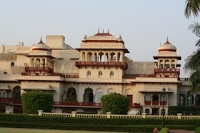
Rambagh Palace
We spent 3 days in Jaipur. Stayed at Hotel Rambagh Palace, which was built in 1835 by the Queen of Jaipur but later converted into a heritage hotel run by the Taj group. The hotel is beautiful – huge room with high ceilings, arches, facades and jharokas. Paintings of all the Kings are hung in different places. The restaurants all remind you of an era long gone- the grandeur and the look and feel of those olden days are still maintained. The Hotel houses a Golf club and Polo grounds and a wonderful garden- a veritable delight for bird watchers.  There are over 75 varieties of common and rare birds.
Entrance to Amber Fort
We spent a day at the Amber Fort and Palace. Set against the rather drab and rugged mountain background, the honey colored Fort and Palace are a sight to watch. Earlier the Jaigarh Fort used to protect the Amber Palace but later the Amber Fort was constructed. The Palace is beautiful and overlooks the Maota Lake below. Parts of the movie Jodha Akbar were shot there. What I found the most  alluring was the Sheesh Mahal- a single light was reflected into multiple images. The Diwan-e-aam, the Diwan-e-Khaas, the Jai Mandir, the Kali temple ,the latticed walls and the intricate gardens all have stories to tell. Please don’t miss out on the light and sound show of Amber Fort.
Moata Lake
After a visit to the Amber Palace we went to the City Palace. The royal family still resides in a portion of the city palace, the Chandra Mahal. It is a blend of Moghul and Rajasthan Architecture and has numerous gardens and courtyards. Other places, which caught my interest, were

Hawa Mahal
Hawa Mahal- The Palace of Winds, which was built by Sawai Pratap Singh. It overlooks the marketplace, the Sireh deorhi Bazaar. It is a wall (behind which there is a 5 storied building) and in olden time the ladies of the royal family used to watch the happenings in the market place through the multiple windows of the Mahal. It now houses a museum.

Nahargarh Fort
Nahargarh and Jaigarh Forts- The Jaigarh Fort is close to the Amber Palace and Fort and the Nahargarh Fort is a little away from Jaipur. The Nahargarh Fort is a beautiful place and though it doesn't attract many tourist compared to Amber Fort it is a must see place.          

Jal Mahal- Palace within a lake, this was created in 1799 by constructing a dam within the lake. In the evenings it is lighted up beautifully
Albert Museum
Albert Museum- a public museum situated in the Ram Niwas Bagh. 
Apart from these the Jantar Mantar, Dolls museum, Birla planetarium are common tourist spots. For those who want to visit religious shrines the Govindji temple, Jagat Shiromani temple and the Lakshminarayan temple are places to visit.  
Jaipur has extreme temperatures so it would be a good idea to check out the weather before you travel.  It’s a shoppers paradise with MI road, Tripolia bazaar, Johari bazaar, Khajane walon ka rasta and multiple other places where one can shop for textiles (the Jaipuri rajais, bedcovers), semi precious stones,  lac work, marble works, miniature paintings. . If you visit during the festival seasons the Gangaur Festival, the Kite festival are quite famous.
Before you leave Jaipur don’t forget to gorge on the delicacies of the Laxmi Misthan Bhandar. Amazing Rajasthani food!.I left Jaipur with memories of a beautiful city full of history and culture. And of course lots of clothes and Jaipuri rajais J.
Contributed by Jayashree Mishra and first published in Enigmaticindia.info site in July 2011

Trip to Aurangabad(Built by the Throne), Maharashtra


Ajanta Caves
Declared as the tourist capital of Maharashtra, Aurangabad(named after Emperor Aurangzeb) is also known as the "City of Gates". I did a weekend trip to Aurangabad and kind of fallen in love with the place...wish I lived in a place like that.

From Mumbai took the Devagiri express at 9 PM on a Friday evening. After a long time travelled in a long distance train-the journey was uneventful-the train left on time and reached around 4:30 AM. People had been scaring and discouraging me not to go there in the peak of summer- but reached there to find that it was surprisingly cool- it had rained the previous day. What struck me most was the cleanliness and absence of crowd (I guess any place after Mumbai would feel the same way).

Ellora Caves
Left for Ajanta after breakfast- took us around 2 hrs by road…the scenery and landscape isn’t much during the summers-people say it looks beautiful after the rains. Ajanta has around 26 caves- but 4-5 of them have paintings- the rest have carvings. The paintings are amazing considering the fact that they are so old- they are 3 dimensional and based on the Jataka tales…the caves are lined in the form of a horse shoe. In earlier times there was a river/spring flowing by and water used to cover the floors of the caves and sunlight would reflect from them and light up the painting and the walls ….To preserve the paintings, photography is not allowed inside. After wandering around the caves for a long time…Spent some time at the local shop that sells semi precious stones…then went back to the hotel.

The second day turned out to be pretty hectic…went early morning to Ellora. Ellora consists of 34 Hindu and Buddhist caves. Was awed by the main cave- cave 16-the Kailashnath temple – a free standing monolith carved top down from a single mountain rock. It depicts scenes from the Ramayana and Mahabharata. The statues look so full of life! The Buddhist caves are beautiful- I could have spent an entire day there…but didn’t have the time…After a couple of hours went visiting temples….there’s a Jyotirlinga  temple- and then went to a Hanuman temple- where the idol of Lord Hanuman is in a sleeping position. 

En route stopped at the Daulatabad Fort- another lovely place…loved the defense mechanisms they have- the mazes…the trenches, moats, watch towers- imagine the amount of thinking that must have gone into it. It was an amazing trip into history. 
Bibi Ka Maqbara

 In the evening went to Bibi ka Maqbara- the grave of Aurungzeb's fourth wife…it is an imitation of Taj Mahal. It is built on the same line but of half marble and the rest of seashell powder. Owing  to its similarity its called the Mini Taj of the Deccan. Due to lack of water, maintenance of the gardens isn’t what is should be. 

After that went to a place called Panchakki- at first glance it looks like a mere pond- and you wonder what’s so great about it- its actually a reservoir which is fed by water from a source that is about 5-6 kms away….water comes in through earthen pipes…its a great engineering feat considering that it was built in the 17th century ….And a question crossed my mind- if problems like these had a solution then …..whats stops the govt now..to take measures to solve people’s problems…There’s a small place near Aurangabad called Jalgaon (the name seems ironic!!)- where water supply is there only once a week.

The day was almost coming to an end- had to catch the 11:30 Devagiri express back- but stopped by for a short time to see how weaving of saris and shawls is done (Paithani and Himroo are the famous saris of the place). Left the place with lovely memories and a resolve to revisit. 2 days definitely isn’t enough to see Aurangabad.

For those who want to visit, Aurangabad is well connected by road and rail. There are connecting flights to the metros. Good time to visit is October to February.
(Contributed by Jayashree Mishra and first published in Enigmaticindia.info site in July 2011)

Wednesday, October 15, 2014

Trip to Udayagiri-Khandagiri Caves, Odisha

The Udayagiri-Khandagiri caves are just 5-6 Kms from the capital city of Bhubaneshwar, Odisha.

Located on two adjacent hills or hillocks, these are caves made for Jain monks during the reign of King Kharavela(193 BCE – after 170 BCE).

There are 18 caves in Udayagiri and 15 caves in Khandagiri. The climb to the caves is quite steep and is not friendly for senior citizens. The inscriptions are in Brahmi, Oriya, Devanagiri and in some places in Sanskrit. Some of the important caves are the Ganesh Gumpha, Sarpha Gumpha and Hathigumpha.

Beware of monkeys and vendors/shopkeepers will sell you peanuts which can be offered to the apes.

Do take time out to visit this historical place.
 

Blog Archive

Followers